

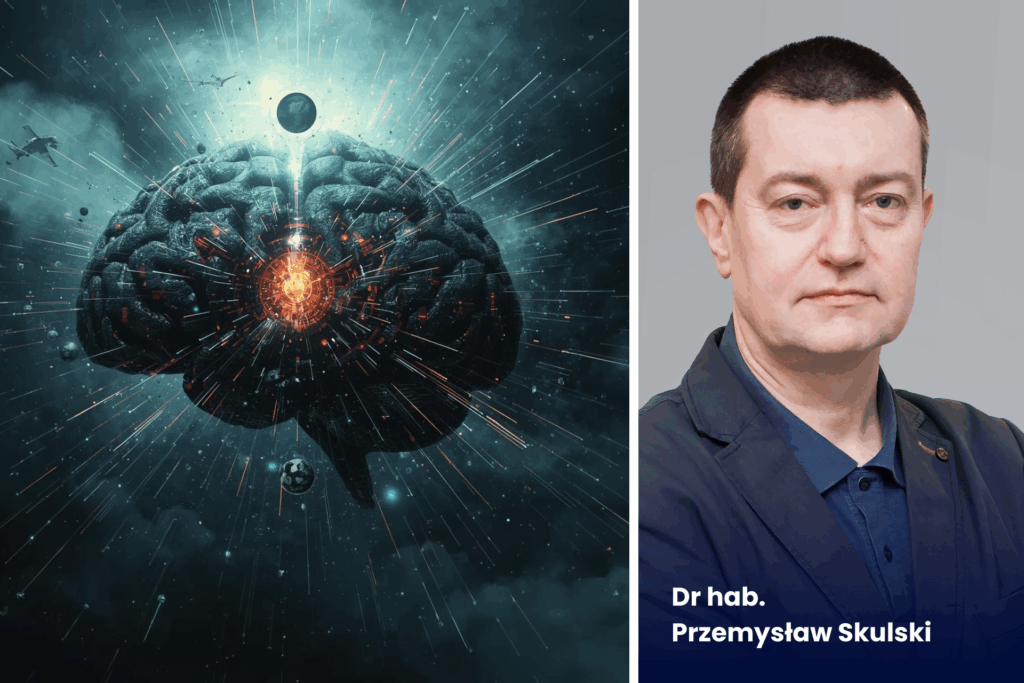
Imagine a country where the most potent weapon is not a missile but a headline. This is not fiction. It is the information environment we all share—and the terrain on which Russia tests Europe’s resilience. In a Radio Wrocław conversation, Przemysław Skulski (Associate Professor at WUEB) joins security specialists and a psychotherapist to unpack how hybrid tactics target both institutions and emotions.
“Social Glue” and Cognitive Warfare: A WUEB Perspective
Przemysław Skulski, Associate Professor at WUEB, a scholar of international economic relations and defence markets at WUEB, opens with a deceptively simple call: “common sense and thinking”. Behind these words stands a clear diagnosis of what hybrid operations seek to erode.
“Common sense and thinking. I believe this is a good remedy—and a reminder of what we might call social glue: trust in state institutions, regardless of who holds power at a given moment. We may not fully agree with them, but let’s trust them. Without that trust, we can be played in ways that others decide.”
This “social glue” – confidence in institutions, procedures and the security system has become a prime target. Prof. Skulski notes that hybrid conflict now includes:
- cognitive warfare: shaping what people think and how they think,
- political polarisation that makes societies easier to manipulate,
- narratives portraying the state as ineffective or chaotic.
From an international-relations standpoint, security cannot be reduced to tanks and missiles. Poland acts within broader frameworks – the EU and NATO – and reactions to provocations must account for alliance commitments, political costs and long-term coherence. At the same time, the absence of a response can be as damaging as an emotional, improvised one.
Fear and Panic: What Happens to Us Under Threat?
Hybrid warfare unfolds not only at borders or in cyberspace, but also within the human mind. Psychotherapist Aleksandra Marciniak notes that heightened fear strengthens the need for control. Publicly critiquing the actions of security services, questioning decisions or “expertising” online may create a sense of influence, yet in practice increases vulnerability to manipulation.
From a psychological perspective, recognising and naming fear matters. It involves:
- asking what is within our control and what is not,
- grounding ourselves in verified facts and context,
- seeking support in shared conversations and collective processing of difficult news.
- Security expert Dr R. Gwardyński adds another essential layer: information hygiene. This means:
- avoiding unverified, sensational sources,
- following official channels responsible for public safety,
- relying on media that have earned social trust rather than those driven by emotional escalation.
In crisis communication, the absence of information opens space for disinformation – but an overload of chaotic messages creates similar effects. Here the role of experts is central: translating complex processes into clear, measured communication.
From Emergency Backpacks to 0.3% of GDP: Resilience in Practice
At one point, the discussion turns to a simple symbol: the emergency backpack. Easy to mock, yet in this conversation it becomes something else entirely—a tool for managing uncertainty.
Having a crisis kit prepared—for floods, blackouts or sheltering at home—helps people:
- acknowledge the reality of threats,
- regain a sense of agency, as highlighted by Prof. Skulski,
- avoid panic by knowing what to do “here and now”.
Colonel P. Kęsicki highlights another pillar of national security: alongside the armed forces stands civil protection. A new law inspired by Finnish and Swedish models, and the decision to allocate 0.3% of GDP to civil protection, strengthen this pillar.
These are concrete measures: responsibilities assigned to local leaders, command-post exercises, realistic evacuation drills and preparedness training for schools, universities and public institutions. As the experts note, professional voices are finally gaining ground – but expertise must be matched with motivation and readiness to act. Only then do knowledge and skills translate into resilience, including resistance to stress.
This is also where the academic role emerges. For Professor Skulski, analysis spans both global strategies (NATO, EU, Nordic approaches) and the very local realities of municipalities, schools and universities. It is at this intersection that societal resilience is built.
What Comes Next?
The conversation leaves the listener with demanding questions:
- Can we trust institutions without idealising them?
- Can we recognise manipulation when it appeals to emotions rather than facts?
- Do we treat education on security and crisis communication as a one-off task—or as a continuous process woven into daily life?
Listen to the full interview on the Radio Wrocław: https://www.radiowroclaw.pl/articles/view/156069/Rozne-punkty-slyszenia-Rosja-testuje-odpornosc-Panika-to-prezent-dla-Moskwy
badania.uew.pl – because in a world where panic has become a tool, measured and competent voices matter most.
Selected Publications of Associate Professor Przemysław Skulski:
Author: Barbara Grzelczak
See similar content

WUEB Experts Weekly Review. Research, Projects and Academic Successes (12–18 October 2026)
How can economic fluctuations be smoothed? The 2026 Nobel Prize in Economic Sciences through the eyes of WUEB researchers
Wroclaw’s micro-hub at the Economic Forum. Natalia Szozda, Associate Professor, on when a city truly becomes smart
WUEB Experts Weekly Review. Research, Projects and Academic Successes (5–11 October 2026)
See also
WUEB Experts Weekly Review. Research, Projects and Academic Successes (12–18 October 2026)
How can economic fluctuations be smoothed? The 2026 Nobel Prize in Economic Sciences through the eyes of WUEB researchers
The World Within Wrocław’s Reach. How the PROM research mobilities confirm WUEB’s place on the map of global academia
Wroclaw’s micro-hub at the Economic Forum. Natalia Szozda, Associate Professor, on when a city truly becomes smart
Dr hab. Aleksander Mercik, Professor of the WUEB, receives the Andrzej Gospodarowicz Award in Finance from the President of the Polish Academy of Sciences
WUEB Experts Weekly Review. Research, Projects and Academic Successes (5–11 October 2026)
Wroclaw University of Economics and Business researchers among the world’s leading scientists: six included in the 2026 World’s Top 2% Scientists database