
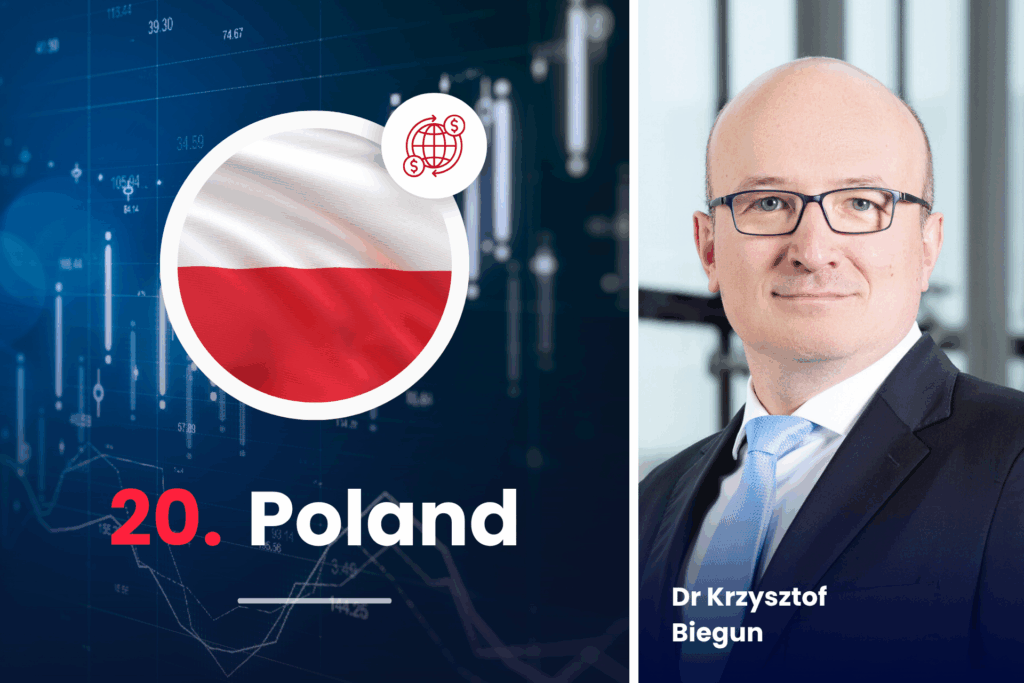
A recent debate on Radio Wrocław examined Poland’s symbolic “promotion” to the group of the world’s 20 largest economies. Among the invited experts was Krzysztof Biegun, PhD, economist at the Wroclaw University of Economics and Business (WUEB) and member of Team Europe Direct. While macroeconomic indicators such as GDP may appear impressive, the researchers emphasized that statistics do not always reflect the reality experienced by households.
The guests included: Adam Karpiński PhD, economist at WSB Merito and Rafał Czarnecki – University of Lower Silesia (DSW).
A Success of a Generation
Krzysztof Biegun emphasized that, from the perspective of the past 30 years, Poland’s transformation has been a remarkable success. Measured in purchasing power parity (PPP), the Polish economy has caught up with Japan—a comparison that once seemed unimaginable. Life expectancy in good health has also improved, and Poles now report higher life satisfaction than, for instance, Italians or Greeks.
“Over the past decades, we have achieved a tremendous economic success on a global scale—not only as Poland, but as an entire Central and Eastern European region.”
Dr Adam Karpiński highlighted that Poland still lags behind Germany in terms of disposable income—the money left after taxes and essential living costs. In other words, the economy may be growing, yet citizens’ lived experiences often fail to keep pace with the data.
At the same time, he cautioned against equating prosperity solely with GDP. Indicators such as quality of life, the stability of public services, and the economy’s capacity for innovation are equally important.
Challenges and Structural Weaknesses
Rafał Czarnecki pointed out the geopolitical aspect of Poland’s invitation to join the G20. In his view, the move is primarily representative and political rather than purely economic. Poland remains a “frontline hub” — strategically significant in terms of economy, politics, and security.
The experts also discussed key structural challenges: low levels of research commercialisation, demographic decline, and rising labour costs. These factors may undermine competitiveness unless bold investments in education, research, and development are made.
A Chance Not to Be Wasted
Summing up, Krzysztof Biegun PhD reminded listeners that Poland’s achievements of the past decades were made possible by favourable global conditions, EU membership, and a well-educated society. Now, facing new challenges such as artificial intelligence, energy security, and population ageing, long-term and thoughtful strategies are essential.
The experts agreed: Poland has entered an elite circle—but staying there will require more than good communication. Real progress depends on connecting economic potential with innovation and institutional stability.
badania.uew.pl – because in a world full of noise, competent voices matter.
We encourage you to listen to the full broadcast on the website of Polish Radio Wrocław – https://www.radiowroclaw.pl/articles/view/154065/Rozne-punkty-slyszenia-Czy-Polska-rzeczywiscie-dogania-bogatszy-Zachod
Author: Barbara Grzelczak
See similar content

WUEB Experts Weekly Review. Research, Projects and Academic Successes (24 – 30 August 2026)
WUEB experts weekly rewiev. Research, Projects and Academic Successes (17–23 August 2026)
WUEB Experts Weekly Review. Research, Projects and Academic Successes (10–16 August 2026)
WUEB Experts Weekly Review: Research, Projects and Academic Successes (3–9 August 2026)
See also
What comes after a PhD? Dr Milena Kowalska at the Economic Forum in Karpacz
Bridging V4 Universities and Business through Design Thinking
WUEB Experts Weekly Review. Research, Projects and Academic Successes (24 – 30 August 2026)
Visual Simulation of Business Processes (WSPB) joins the Polish Roadmap for Research Infrastructures
WUEB experts weekly rewiev. Research, Projects and Academic Successes (17–23 August 2026)
WUEB awarded Visegrad grant to study the skills gap across the V4
Prof Małgorzata Krzywonos joins the Management Committee of COST Action BRASSCHI