

Household debt in Poland is rising. UEW experts explain the mechanisms behind debt, the psychology of money, and realistic ways out of financial trouble. Debt rarely begins with a dramatic decision. More often, it grows out of small, seemingly harmless choices that quietly accumulate. In the Radio Wrocław programme Different Points of View: In Debt Like a Pole, experts looked beyond statistics to explain why losing control over finances has become so common.

When debt becomes more than mathematics
In the Radio Wrocław debate Different Points of View: In Debt Like a Pole, the discussion focused not only on figures, but on the mechanisms that push people into financial distress. One of the expert voices was Iwo Augustyński, PhD. from the Wrocław University of Economics and Business, who stressed that debt is not merely a mathematical issue. It is also psychological and systemic.
A spiral that begins quietly
According to data from BIG InfoMonitor and BIK, nearly 2.5 million people in Poland struggle to repay their liabilities. Average arrears exceed PLN 34,000, while overdue mortgage debt reaches as much as PLN 262,000. These figures are striking, yet they do not explain how people arrive at this point.
As the panellists noted, problems rarely start with a mortgage. More often, they begin with unpaid phone bills, overdue rent, or instalments stretched “just a little longer”. What matters most is the accumulation of obligations – especially when debts overlap.
Iwo Augustyński, PhD. highlighted a frequently underestimated factor: compound interest.
“Over time, debt can grow into enormous amounts. The original sum becomes only a small fraction of what eventually has to be repaid. People tend to underestimate how fast interest accumulates.”
This mechanism turns what seems like a temporary difficulty into a self-sustaining spiral.
Impulse, marketing and the illusion of “easy money”
The conversation opened with Black Friday and Cyber Monday – and not by accident. Zero-interest instalments, “buy now, pay later”, or “we cover the first payments” have become standard sales tools. Behind them lie advanced algorithms, data analytics and behavioural psychology.
Consumers are expected to act rationally, while on the other side entire teams work to trigger immediate purchasing decisions. In this imbalance, impulsive choices are easy – especially when money becomes almost invisible, reduced to a tap in an app.
Importantly, debt is not confined to low-income households. As the experts noted, high earners also fall into debt, often by overinvesting or overestimating their future financial capacity.
The paradox of debt and a measure of wellbeing
The debate also pointed to a paradox: the number of debtors is falling, yet the average level of debt is rising. This suggests that financial problems are becoming concentrated among those in serious difficulty, for whom escape is increasingly hard.
Dr Augustyński argued that debt statistics are a meaningful indicator of social wellbeing. GDP growth alone tells little if it is accompanied by mounting financial strain on households. In this sense, debt data often reveal more about real living conditions than headline macroeconomic figures.
How to break the spiral: practical steps
The second part of the discussion focused on solutions. The experts agreed that early action is critical:
- Assess the full scale of debt without avoidance or delay. It is essential to know exactly how much is owed, to whom, and under what terms,
- Contact and negotiate with creditors. Creditors usually prefer partial recovery to none at all. Options may include extended repayment periods or debt consolidation,
- Do not avoid communication. Ignoring calls and letters only accelerates legal proceedings, where room for negotiation is minimal,
- Rebuild the household budget. This means aligning spending with actual income and gradually creating a financial safety buffer.
The key principle, as emphasised, is managing the money we actually have—not the money we expect to earn in the future.
Consumer bankruptcy: a last resort
The final part of the programme addressed consumer bankruptcy. Dr Augustyński made it clear that this is neither a financial “reset” nor an easy solution. Bankruptcy involves asset seizure, long-term income restrictions and a heavy psychological burden, often affecting entire families. It is a measure of last resort, to be considered only when all other options are exhausted.
The discussion closed with a sentence that captured its core message:
Debata zakończyła się zdaniem, które najlepiej podsumowuje całą rozmowę:
Consume – but with your own money.
Simple, almost obvious. Yet in a world of easy credit, aggressive marketing and digital payments, it remains one of the most important lessons of everyday economics.
Author: Barbara Grzelczak
badania.uew.pl – because the world needs competent voices when noise drowns out reason.
See similar content

WUEB Experts Weekly Review. Research, Projects and Academic Successes (12–18 October 2026)
How can economic fluctuations be smoothed? The 2026 Nobel Prize in Economic Sciences through the eyes of WUEB researchers
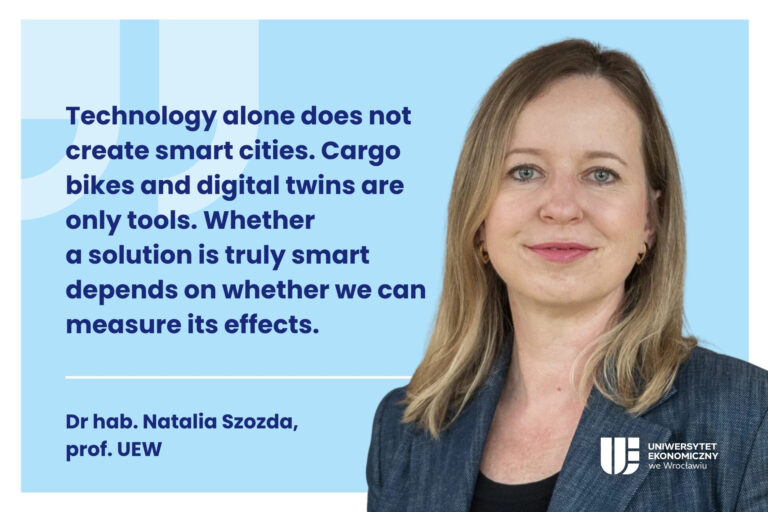
Wroclaw’s micro-hub at the Economic Forum. Natalia Szozda, Associate Professor, on when a city truly becomes smart
WUEB Experts Weekly Review. Research, Projects and Academic Successes (5–11 October 2026)
See also
WUEB Experts Weekly Review. Research, Projects and Academic Successes (12–18 October 2026)
How can economic fluctuations be smoothed? The 2026 Nobel Prize in Economic Sciences through the eyes of WUEB researchers
The World Within Wrocław’s Reach. How the PROM research mobilities confirm WUEB’s place on the map of global academia
Wroclaw’s micro-hub at the Economic Forum. Natalia Szozda, Associate Professor, on when a city truly becomes smart
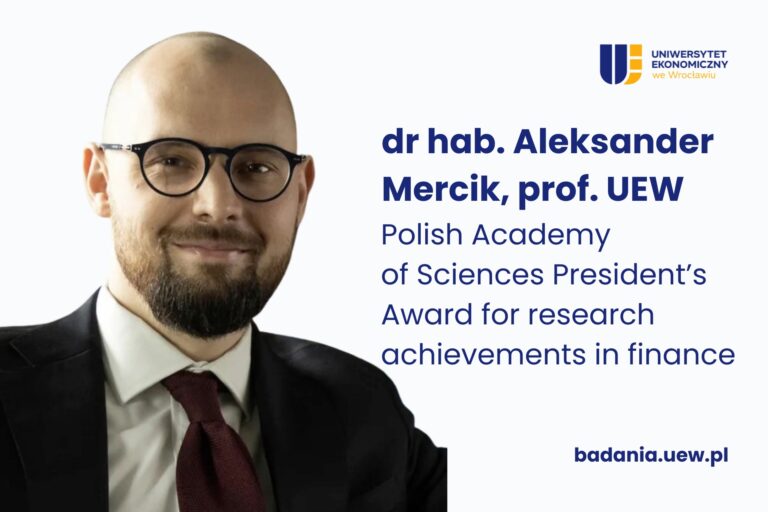
Dr hab. Aleksander Mercik, Professor of the WUEB, receives the Andrzej Gospodarowicz Award in Finance from the President of the Polish Academy of Sciences
WUEB Experts Weekly Review. Research, Projects and Academic Successes (5–11 October 2026)
Wroclaw University of Economics and Business researchers among the world’s leading scientists: six included in the 2026 World’s Top 2% Scientists database