

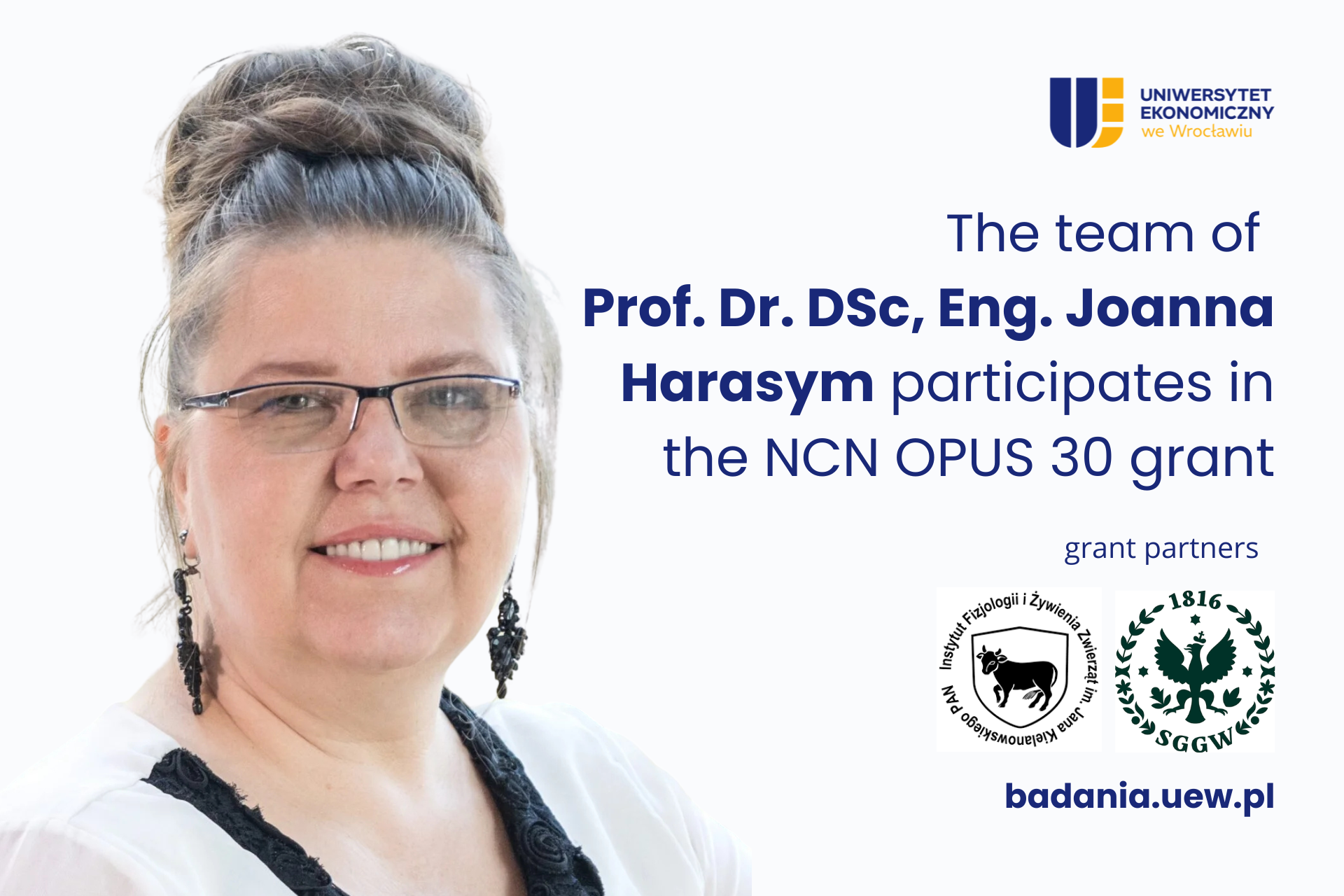
Inflammatory bowel diseases are increasingly understood not only in pharmacological terms but also through the lens of targeted nutritional interventions that may support the intestinal barrier, modulate the gut microbiota, and shape the host immune response. A research team led by Prof. Joanna Harasym, DSc, PhD, Eng., from Wrocław University of Economics and Business is participating in a National Science Centre grant investigating the therapeutic potential of an amino acid and oat beta-glucan mixture as a candidate adjunct in the management of ulcerative colitis. WUEB’s contribution centres on Task 1: developing the preparation method and characterising the mixture, a step on which the quality of all subsequent preclinical work depends.
The gut–microbiota–liver axis under scrutiny
Ulcerative colitis is a chronic inflammatory bowel disease for which there remains a pressing need for effective, accessible, and sustainable long-term adjunctive strategies. Nutritional interventions represent one active line of inquiry, given their potential to attenuate inflammation, reinforce the intestinal barrier, modulate microbial communities, and influence host metabolism.
This project, funded by the National Science Centre (Narodowe Centrum Nauki, NCN), addresses precisely this area. It is conducted by a consortium of three institutions: the Warsaw University of Life Sciences (SGGW) as lead partner, Wrocław University of Economics and Business, and the Kielanowski Institute of Animal Physiology and Nutrition of the Polish Academy of Sciences. The total grant value is PLN 3,269,661, of which WUEB’s budget amounts to PLN 1,101,660.
WUEB’s task: formulation development as the foundation of the study
The WUEB team is led by Prof. Joanna Harasym, DSc, PhD, Eng., of the Department of Biotechnology and Food Analysis, Faculty of Production Engineering. The team is responsible for developing a robust preparation method and providing full physicochemical and functional characterisation of the amino acid and oat beta-glucan mixture.
This is a rate-limiting step for the entire project. The quality, batch-to-batch reproducibility, and defined properties of the prepared mixture are prerequisites for the validity of downstream in vivo studies and for meaningful analysis of its effects on gut–microbiota–liver axis activity. WUEB thus holds responsibility for the technological and analytical component that conditions the reliability of all subsequent preclinical stages.
Why beta-glucan and amino acids?
The intervention under investigation combines oat beta-glucan with a defined amino acid mixture. Oat beta-glucan is a well-characterised compound with established prebiotic, anti-inflammatory, and antioxidant properties. Selected amino acids, in turn, may support intestinal mucosal regeneration and modulate the inflammatory response. The project tests whether the combined formulation produces a favourable biological effect and whether it could form the basis for a cost-effective, evidence-grounded adjunctive strategy in UC management.
Three institutions, three complementary research tasks
The project is structured around three interlocking research tasks. WUEB prepares and characterises the amino acid and oat beta-glucan mixture. SGGW, together with the Kielanowski Institute, conducts in vivo studies in a porcine model of ulcerative colitis, assessing the effects of the mixture. SGGW is also responsible for evaluating the impact of the formulation on gut–microbiota–liver axis activity.
The analytical scope of the project operates across multiple biological levels: microbiological, immunological, metabolomic, and transcriptomic. This design enables assessment not only of local intestinal changes but also of systemic responses, including gut–microbiota–liver axis dynamics. The framing is clinically appropriate: ulcerative colitis is not a disease confined to the intestinal lumen but a disorder engaging the immune system, the gut microbiome, and metabolic pathways simultaneously.
The selection of a porcine model carries specific scientific rationale. The gastrointestinal tract of the pig exhibits high anatomical and physiological similarity to that of humans, making results obtained in this model of greater translational value than those derived from simpler experimental systems.
A further stage in long-term beta-glucan research
WUEB’s participation is not a one-off collaboration. It represents the continuation of Prof. Harasym’s sustained research programme on beta-glucan and the latest phase of an ongoing scientific partnership with SGGW. This is the second consortium grant conducted with SGGW and partner institutions, and the fifth joint OPUS grant between Prof. Harasym and SGGW focused on beta-glucan.
From preclinical findings to potential therapeutic support
The significance of this project extends beyond the characterisation of a single food ingredient. If the research hypothesis is confirmed, the results may provide a scientific basis for developing a natural, cost-accessible, and preclinically documented strategy for adjunctive management of ulcerative colitis. For patients, this could represent a new evidence-supported avenue of therapeutic support; for the scientific community, it offers deeper insight into the relationships between dietary compounds, the gut microbiota, inflammatory signalling, and host metabolism.
Grant value: PLN 3,269,661. NCN number: 2025/59/B/NZ4/03357.
badania.uew.pl, because the world needs competent voices where decisions require knowledge, evidence, and responsibility.
Author of text: Justyna Morawska-Płoskonka
See also
Dr hab. Aleksander Mercik, Professor of the WUEB, receives the Andrzej Gospodarowicz Award in Finance from the President of the Polish Academy of Sciences
Wroclaw University of Economics and Business researchers among the world’s leading scientists: six included in the 2026 World’s Top 2% Scientists database
Vitamins C and D in a single plant-based gel: UEW researcher awarded NCN grant

Joanna Radomska of WUEB awarded the title of professor
See similar content
How can economic fluctuations be smoothed? The 2026 Nobel Prize in Economic Sciences through the eyes of WUEB researchers
The World Within Wrocław’s Reach. How the PROM research mobilities confirm WUEB’s place on the map of global academia
Wroclaw’s micro-hub at the Economic Forum. Natalia Szozda, Associate Professor, on when a city truly becomes smart
Dr hab. Aleksander Mercik, Professor of the WUEB, receives the Andrzej Gospodarowicz Award in Finance from the President of the Polish Academy of Sciences

WUEB Experts Weekly Review. Research, Projects and Academic Successes (5–11 October 2026)
Wroclaw University of Economics and Business researchers among the world’s leading scientists: six included in the 2026 World’s Top 2% Scientists database
WUEB Experts Weekly Review: Research, Projects and Academic Successes (28 September–4 October 2026)