
Bridging V4 Universities and Business through Design Thinking (First Event – Wrocław)
21-23 października 2026
Szanowni Państwo,
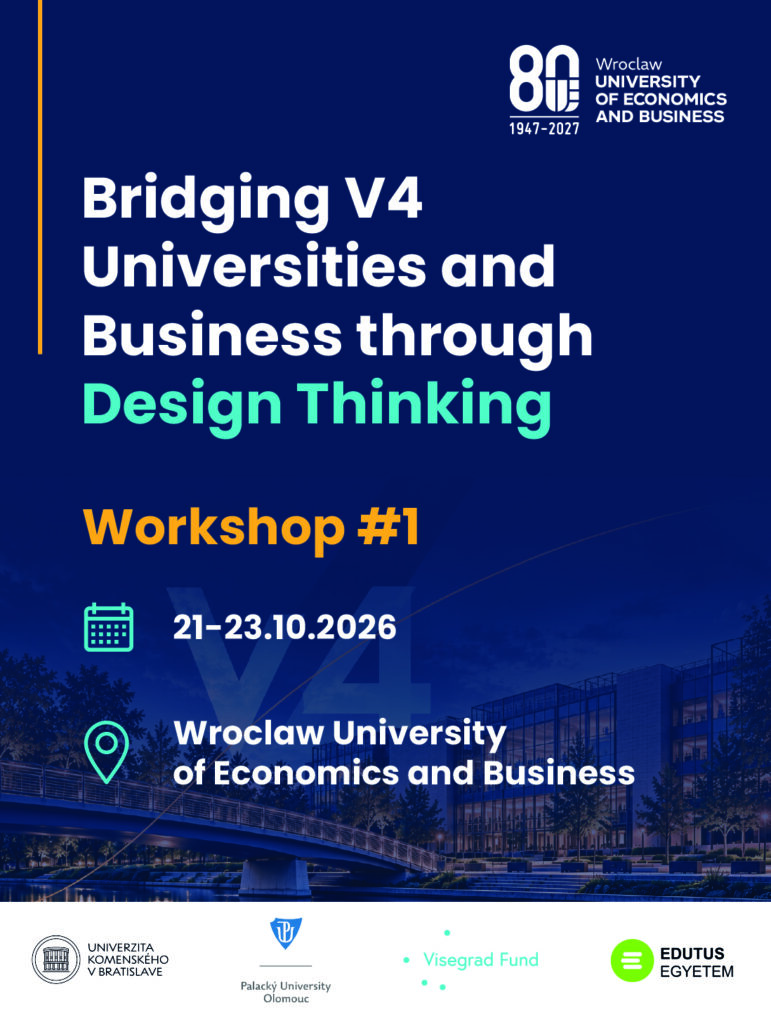
Mamy zaszczyt zaprosić na pierwsze międzynarodowe warsztaty realizowane w ramach projektu „Bridging V4 Universities and Business through Design Thinking”, które odbędą się w dniach 21-23 października 2026 r. na Uniwersytecie Ekonomicznym we Wrocławiu.
W wydarzeniu wezmą udział studenci oraz przedstawiciele kadry z czterech uczelni partnerskich reprezentujących kraje Grupy Wyszehradzkiej: Uniwersytetu Ekonomicznego we Wrocławiu, Palacký University Olomouc, Comenius University Bratislava oraz Edutus University. Studenci będą pracować w międzynarodowych zespołach, natomiast kadra z uczelni partnerskich będzie wspierać przebieg warsztatów, facylitację pracy zespołowej oraz proces obserwacji i ewaluacji.
Hasłem przewodnim warsztatów będzie: „Od kompetencji do pierwszej pracy – jak się przygotować?”.
Partnerem biznesowym pierwszego warsztatu będzie QIAGEN – międzynarodowa firma specjalizująca się w produktach i usługach z zakresu badań molekularnych, odkrywania biomarkerów oraz technologii digital PCR. Firmę reprezentować będą przedstawiciele obszaru Accounting Operations.
Celem warsztatów będzie przygotowanie studentów do wejścia na rynek pracy oraz rozwijanie umiejętności skutecznego prezentowanie kompetencji zdobytych podczas studiów.
Przedstawiciele QIAGEN będą pełnić rolę ekspertów biznesowych. Ich zadaniem będzie dzielenie się wiedzą dotyczącą procesów rekrutacyjnych i oczekiwań pracodawców, odpowiadanie na pytania studentów, konfrontowanie przyjmowanych przez zespoły założeń z praktyką organizacyjną oraz przekazywanie praktycznej informacji zwrotnej dotyczącej wypracowanych rozwiązań.
Warsztaty poprowadzi Kamila Łuczak (UEW) przy wsparciu Macieja Krahela (UEW).
W wydarzeniu uczestniczyć będzie również kadra z uczelni partnerskich projektu. Jej rolą będzie wspieranie pracy zespołów, wprowadzanie wybranych narzędzi i metod Design Thinking, dbanie o przebieg poszczególnych etapów pracy oraz aktywny udział wszystkich studentów. Przedstawiciele uczelni partnerskich będą również obserwować mocne strony oraz trudności pojawiające się podczas pracy zespołowej i dokumentować spostrzeżenia, które zostaną następnie wykorzystane w dalszych działaniach projektowych.
Projekt jest współfinansowany przez rządy Czech, Węgier, Polski i Słowacji w ramach Visegrad Grants z International Visegrad Fund.
Serdecznie zapraszamy do udziału!
Paulina Graczyk
w imieniu Komitetu Organizacyjnego
Dear All,
We are pleased to invite you to the first international workshop organised as part of the “Bridging V4 Universities and Business through Design Thinking” project, which will take place on 21-23 October 2026 at the Wroclaw University of Economics and Business.
The event will bring together students and staff from four partner universities representing the Visegrad Group countries: Wroclaw University of Economics and Business, Palacký University Olomouc, Comenius University Bratislava, and Edutus University. Students will work in international teams, while staff from the partner universities will support the workshop process, facilitate teamwork, and contribute to observation and evaluation activities.
The main theme of the workshop will be: “From Competences to First Job – How to Prepare?”
The business partner of the first workshop will be QIAGEN, an international company specialising in products and services related to molecular research, biomarker discovery, and digital PCR technologies. The company will be represented by members of its Accounting Operations team.
The aim of the workshop is to prepare students for entering the labour market and to develop their ability to effectively present the competences acquired during their studies.
QIAGEN representatives will act as business experts. Their role will be to share their knowledge of recruitment processes and employers’ expectations, answer students’ questions, challenge the assumptions developed by the teams by confronting them with organisational practice, and provide practical feedback on the solutions created during the workshop.
The workshop will be facilitated by Kamila Łuczak (WUEB) with the support of Maciej Krahel (WUEB).
Staff from the project’s partner universities will also participate in the event. Their role will be to support team activities, introduce selected Design Thinking tools and methods, ensure the smooth implementation of individual stages of the workshop, and encourage the active participation of all students.
Representatives of the partner universities will also observe the strengths and challenges emerging during teamwork and document their observations. These insights will subsequently be used in further project activities. The project is co-financed by the governments of the Czech Republic, Hungary, Poland, and Slovakia through Visegrad Grants from the International Visegrad Fund.
We warmly invite you to participate!
Paulina Graczyk
on behalf of the Organising Committee
Tematyka
Główne tematy poruszane podczas warsztatu będą obejmować:
- od doświadczeń akademickich do kompetencji cenionych przez pracodawców – jakie kompetencje studenci faktycznie rozwijają w trakcie studiów oraz w jaki sposób kompetencje te są rozumiane i oceniane przez pracodawców w krajach V4?
- jak analizować rynek pracy i rozumieć oczekiwania pracodawców – w jaki sposób kompetencje są przedstawiane w ofertach pracy oraz jak interpretować wymagania dotyczące stanowisk dla osób rozpoczynających karierę zawodową?
- komunikowanie kompetencji: CV, przykłady i osiągnięcia – jak skutecznie prezentować swoje kompetencje?
- projektowanie pierwszego doświadczenia rekrutacyjnego – jak skutecznie przygotować przejście od złożenia aplikacji do rozmowy kwalifikacyjnej?
Topic
The main topics covered in the workshop will be:
- from academic experiences to employer-valued competencies – what competencies do students actually develop during their studies, and how are these competencies understood and evaluated by employers in the V4 countries?
- how to analyze the job market and understand employers’ expectations – how competencies are communicated in job postings and how to interpret requirements for entry-level positions?
- communicating competencies: resumes, evidence, and achievements – how to effectively present your competencies?
- designing the first recruitment experience – designing an effective transition from application to job interview.
Program
21 października – spotkanie otwierające / 21 October – opening meeting
| Pierwszy dzień wydarzenia będzie poświęcony integracji uczestników oraz przygotowaniu ich do wspólnej pracy. Studenci poznają członków swoich międzynarodowych zespołów, przedstawicieli uczelni partnerskich, eksperta Design Thinking, facylitatorów. Podczas spotkania zostanie również przedstawione i omówione wyzwanie projektowe przygotowane przez QIAGEN, nad którym studenci będą pracować w kolejnych dniach. Przed rozpoczęciem właściwych warsztatów uczestnicy zostaną poproszeni o wypełnienie ankiety wstępnej (pre-event survey). Jej celem będzie diagnoza poziomu wybranych kompetencji studentów związanych z tematyką wyzwania. Wyniki ankiety będą jednym z elementów późniejszej ewaluacji efektów warsztatów. | The first day of the event will focus on participant integration and preparation for collaborative work. Students will meet the members of their international teams, representatives of the partner universities, the Design Thinking expert, and the facilitators. During the meeting, the project challenge prepared by QIAGEN will also be presented and discussed. This will be the challenge that students will work on during the following days. Before the main workshop begins, participants will be asked to complete a pre-event survey. Its purpose will be to assess the level of selected competences related to the workshop topic. The survey results will form part of the later evaluation of the workshop outcomes. |
22 października – warsztat Design Thinking / 22 October – Design Thinking workshop
| Drugiego dnia odbędzie się całodniowy warsztat Design Thinking. Studenci będą pracować w międzynarodowych zespołach nad wyzwaniem przedstawionym przez QIAGEN, przechodząc przez kolejne etapy procesu Design Thinking – od empatyzacji i pogłębionego zrozumienia problemu, poprzez definiowanie potrzeb użytkowników i generowanie pomysłów, aż po prototypowanie oraz testowanie proponowanych rozwiązań. Istotnym elementem warsztatu będzie bezpośrednia współpraca studentów z przedstawicielami biznesu oraz możliwość skonfrontowania swoich pomysłów z doświadczeniami i potrzebami pracodawcy. Wieczorem odbędzie się również spotkanie kadry zaangażowanej w realizację projektu. Będzie ono poświęcone omówieniu obserwacji i refleksji wynikających z pierwszego międzynarodowego warsztatu, w szczególności w odniesieniu do pracy zespołów, zastosowanych narzędzi, aktywności studentów oraz pojawiających się mocnych stron i trudności. | On the second day, a full-day Design Thinking workshop will take place. Students will work in international teams on the challenge presented by QIAGEN, moving through the successive stages of the Design Thinking process – from empathy and a deeper understanding of the problem, through defining user needs and generating ideas, to prototyping and testing proposed solutions. An important element of the workshop will be direct cooperation between students and business representatives, as well as the opportunity to confront their ideas with the experience and needs of an employer. In the evening, a meeting of the academic staff involved in the project will also take place. It will be devoted to discussing observations and reflections from the first international workshop, particularly with regard to teamwork, the tools used, student engagement, and the strengths and difficulties identified during the process. |
23 października – spotkanie zamykające / 23 October – closing meeting
| Ostatniego dnia odbędzie się spotkanie zamykające pierwsze warszaty w ramach projektu, którego celem będzie podsumowanie całego wydarzenia i najważniejszych rezultatów. Spotkanie obejmie prezentację kluczowych efektów pracy, końcowe refleksje oraz dyskusję z udziałem studentów i kadry. Szczególna uwaga zostanie poświęcona doświadczeniom uczestników związanym z pracą w międzynarodowych zespołach, wykorzystaniem metodyki Design Thinking oraz współpracą z przedstawicielami biznesu. Studenci zostaną również poproszeni o wypełnienie ankiety końcowej (post-event survey), która pozwoli porównać wyniki z badaniem przeprowadzonym przed rozpoczęciem warsztatów oraz ocenić zmiany dotyczące wybranych kompetencji. Uzupełnieniem ewaluacji będą rozmowy dotyczące doświadczeń, opinii i informacji zwrotnej zarówno ze strony studentów, jak i kadry. | On the final day, a closing meeting will be held to conclude the first workshops organised within the project. Its purpose will be to summarise the event and its key outcomes. The meeting will include a presentation of the main results, final reflections, and a discussion involving students and academic staff. Particular attention will be given to participants’ experiences related to working in international teams, using the Design Thinking methodology, and cooperating with business representatives. Students will also be asked to complete a post-event survey, which will make it possible to compare the results with the survey conducted before the workshops and assess changes in selected competences. The evaluation will be complemented by discussions focusing on the experiences, opinions, and feedback of both students and academic staff. |
Działania po zakończeniu warsztatów / Activities after the workshop
| Po zakończeniu wydarzenia odbędzie się spotkanie online wszystkich partnerów projektu, podczas którego omówione zostaną rezultaty pierwszych międzynarodowych warsztatów, zebrane obserwacje oraz wyniki ewaluacji. Wnioski z wydarzenia we Wrocławiu posłużą również do przygotowania pierwszej części toolkitu. Doświadczenia z pierwszego warsztatu będą tym samym stanowiły podstawę do dalszego doskonalenia metod pracy oraz przygotowania kolejnych międzynarodowych działań projektowych. | After the event, an online meeting of all project partners will be organised to discuss the outcomes of the first international workshops, the observations collected, and the evaluation results. The conclusions from the event in Wroclaw will also contribute to the preparation of the first part of the toolkit. The experience gained during the first workshop will therefore provide a basis for further improvement of the working methods and for the preparation of subsequent international project activities. |
Miejsce/Place
Uniwersytet Ekonomiczny we Wrocławiu
ul. Komandorska 118/120
53-334 Wrocław
Budynek Z (sala 312) / Building Z (room 312)
Budynek W (sala 4W) / Building W (room 4W)
Kontakt /Contact