
The costs and responsibilities of managing a home’s heating place a considerable burden on many rural residents. Speaking to Interia, dr hab. inż. Arkadiusz Piwowar, Professor of the WUEB, explains the difficulties faced by families using their own boilers and why some people are reluctant to admit that their homes are cold.
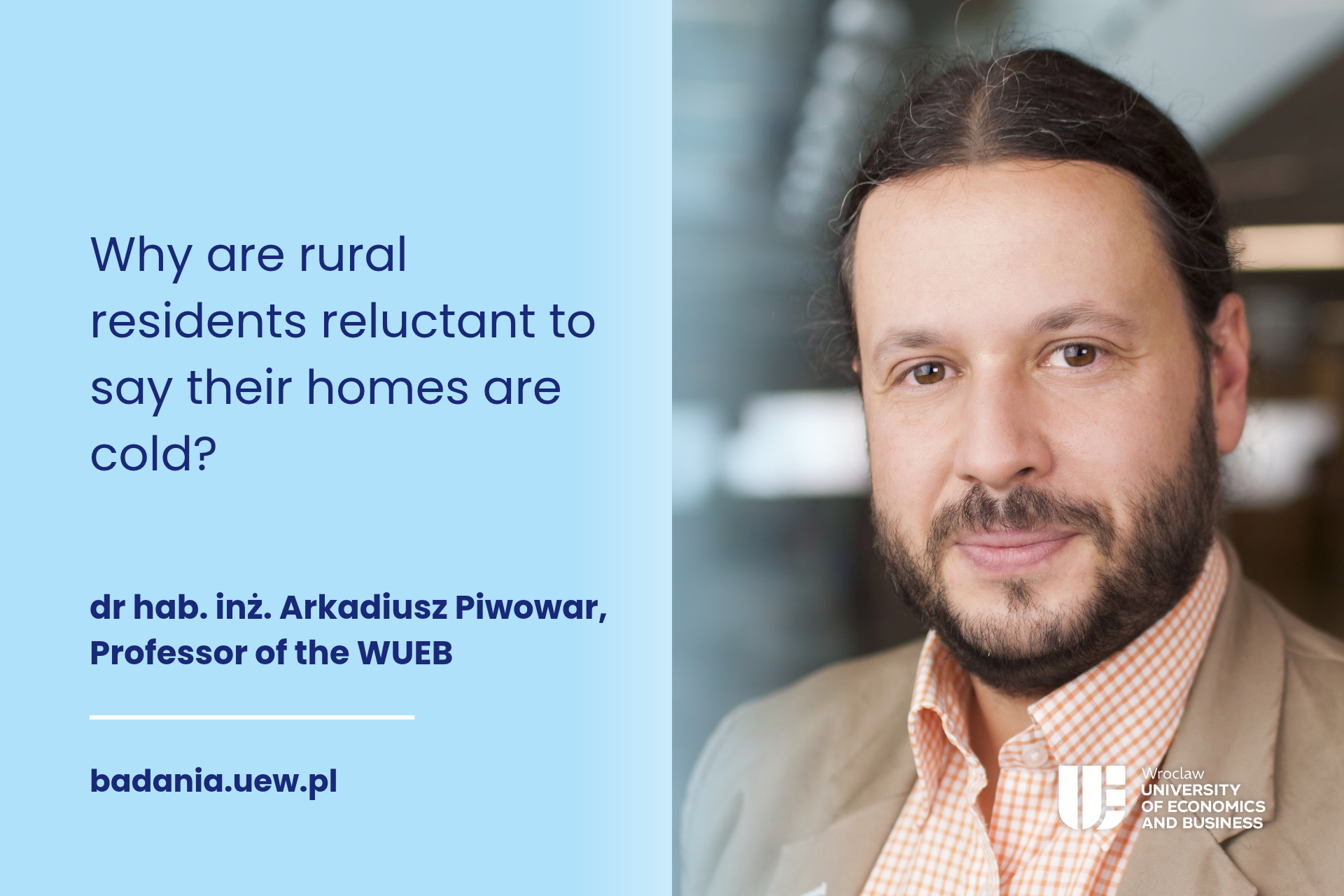
In article published on Interia ‘Winter will divide Poland. Cities do not know what rural communities are dealing with’, the researcher at Wroclaw University of Economics and Business describes the differences between district heating and heating a home independently. His comments concern residents’ everyday responsibilities and difficulties that he examines, among other topics, in his research on energy poverty among farming households in Poland.
How does district heating differ from heating a home independently?
In a home with a solid-fuel boiler, preparing for winter begins with securing fuel supplies. The purchase often involves a substantial one-off expense. The fuel then has to be moved into storage, and the equipment requires regular attention. The WUEB Expert notes that this work falls to residents themselves. The amount spent on heating alone gives little indication of how demanding it can be. The work is also often entrusted to members of the extended family or other people.
Access to infrastructure can restrict the choice of another heating system. As Piwowar explains, much of the countryside remains beyond the reach of district heating and gas networks. Changing the installation also depends on the building’s technical conditions and the money its owner can afford to invest. He stresses that rural housing varies: new, well-insulated homes with modern heating stand alongside older buildings. Energy poverty is, of course, not confined to rural areas. There are also homes in cities whose owners struggle to maintain an adequate indoor temperature.
Nevertheless, dr hab. inż. Arkadiusz Piwowar anticipates that the ageing of rural communities, combined with the low incomes of some older residents, could deepen energy poverty. He also draws attention to people’s reluctance to disclose their difficulties.
‘It is difficult to admit openly that your own home is cold,’
— says Arkadiusz Piwowar
How farmers assess their circumstances
Residents’ accounts of their living conditions were the subject of Piwowar’s research published, for example, in Economics and Sociology. He examined farmers’ knowledge of energy poverty and their assessment of their own circumstances. He considered these responses in relation to the difficulties of measuring the phenomenon, identifying discrepancies between participants’ self-assessments and assessments based on objective measures.
This distinction matters when interpreting the findings. The publications indicate the scale of the problem, while also illustrating a difficulty researchers face when asking about housing conditions in the context of energy poverty: answers also depend on how respondents understand their circumstances. We previously discussed the study in ‘Warmth is not available to everyone. What Polish farmers know and feel about energy poverty’ (in Polish).
What a farming household’s bill covers
The WUEB Expert also analyses electricity costs. In a paper published in Energy Policy, he examined their relationship with the size and composition of farming households. Drawing on surveys of 480 farming households, he identified associations between these characteristics and expenditure. He suggested that the findings could help adapt support programmes to the circumstances of rural families.
On a farm, energy serves both household needs and agricultural production. Without separate meters, it is difficult to determine how much of the bill relates to each use. Comparing the amounts alone can therefore give an incomplete picture of the burden on a family’s budget. We previously examined the relationship between household composition and electricity costs in ‘How much does energy really cost in rural Poland? New research reveals hidden relationships’ (in Polish). Electricity expenditure should not be treated as the total cost of heating.
Dr hab. inż. Arkadiusz Piwowar also addressed the distinction between domestic and agricultural electricity use in a paper published in Scientific Reports in November 2025. He analysed the relationship between the share of expenditure on electricity used in farming and farm characteristics. The study identified associations with the farm’s economic size, production system and type of agricultural production, among other factors.
The WUEB Expert points to the need for precise analysis of energy use and for allocating expenditure to domestic or production needs.
Read the article featuring Arkadiusz Piwowar’s comments – https://biznes.interia.pl/finanse/news-zima-podzieli-polske-miasto-nie-wie-z-czym-zmaga-sie-wies,nId,23577880
Selected publications
Piwowar, A. (2025a). An empirical analysis of electricity use and expenditure in farming households in Poland. Scientific Reports, 15, Article 38904. https://doi.org/10.1038/s41598-025-22762-0
Piwowar, A. (2025b). Electrical energy costs and size and structure of farming households. Study from Poland. Energy Policy, 202, Article 114617. https://doi.org/10.1016/j.enpol.2025.114617
Piwowar, A. (2025c). Self-assessment of energy poverty determinants and effects in farmer households: Findings from Poland. Economics and Sociology, 18(1), 11–26. https://doi.org/10.14254/2071-789X.2025/18-1/1
Author of text: Barbara Grzelczak
See similar content

WUEB Experts Weekly Review: Research, Projects and Academic Successes (16–22 November 2026)
Renewable capacity is growing, yet electricity remains relatively expensive. Dr Paweł Brusiło on Poland’s energy transition
WUEB Experts Weekly Review: Research, Projects and Academic Successes (09.11–15.11.2026 r.)
WUEB Experts Weekly Review: Research, Projects and Academic Successes (2–8 November 2026)
See also
WUEB Experts Weekly Review: Research, Projects and Academic Successes (16–22 November 2026)
Renewable capacity is growing, yet electricity remains relatively expensive. Dr Paweł Brusiło on Poland’s energy transition
WUEB Experts Weekly Review: Research, Projects and Academic Successes (09.11–15.11.2026 r.)
WUEB Experts Weekly Review: Research, Projects and Academic Successes (2–8 November 2026)
Design Thinking in an international setting – the first workshop of the “Bridging V4 Universities and Business through Design Thinking” project is behind us!
Can Europe act together? Dr hab. Przemysław Skulski, professor of the WUEB on collective defence
WUEB Experts Weekly Review. Research, Projects and Academic Successes (26 October–1 November 2026)