

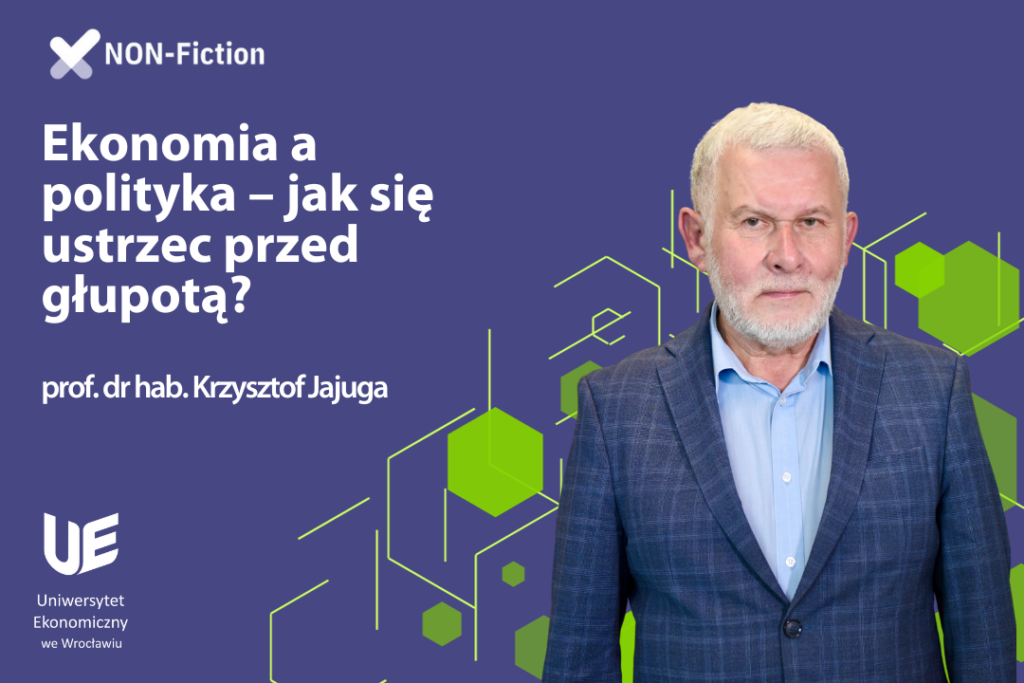
Politics vs. the economy: how economic knowledge helps avoid electoral pitfalls
Prof. dr hab. Krzysztof Jajuga
expert of the Wroclaw University of Economics and Business
In today’s dynamic and complex world, especially in the context of the upcoming elections, politicians’ decisions and economic policies take on fundamental importance.
At such an important time, understanding the principles of economics and being able to think based on facts become key tools to make informed choices. It is economics that provides us with the tools to analyze, evaluate and understand complex economic mechanisms, as well as to predict their impact on our future.
Our informed decisions and choices should be based on sound, expert knowledge, as they affect everyday life and have far-reaching consequences for the economy.
- Economy vs. politics. The decisions of politicians affect our economy in a direct and often long-term way. In pre-election periods we see an avalanche of promises, but economic reality demands a responsible approach. It is necessary to distinguish the term “policy” with an adjective, such as “policy”. “economic policy”, “social” policy, etc. (English “policy”) from the term “politics” (English “politics”). It is crucial to understand that “economic policy” should be conducted by experts who understand its mechanisms, not just “politicians.”
- Priorities in politics – Economy, stupid! Bill Clinton’s famous 1992 election slogan, “It’s the economy, stupid,” holds the truth about priorities in politics. A developed economy is the foundation of social well-being and national development. Therefore, policy decisions should be evaluated through the prism of their impact on our economy.
- Long-term consequences. A country’s position and the well-being of its people are determined by decisions that have long-term consequences, not “here and now” decisions. Our future depends on actions taken now. Therefore, it is important to make decisions with long-term consequences in mind, not just current needs. When we make decisions as a society, we need to think about future generations. Our children, grandchildren, great-grandchildren – their well-being and position in society depend on our actions today. This is Our responsibility!
- Monetary policy and inflation. Inflation targeting in monetary policy is crucial for economic stability. Keynes stated: “Through relentless inflation, the government is able to imperceptibly confiscate most of the wealth of its citizens.” Therefore, the inflation target of monetary policy is of fundamental importance to society. High inflation will not be combated by stating that “it has been nullified.”
- The value of economic education. The best defense against false beliefs is economic education. It is worth listening to experts who analyze data and predict the consequences of economic decisions, although their analyses can sometimes be difficult to understand.